IS IT ART?

I recently came across an edited collection of short accounts by various photographers of the key influences on their work. American street photographer, Saul Leiter, comments: “I go out to take a walk, I see something, I take a picture. I take photographs.” His approach to photography was very selective. Sometimes he went out and came back with nothing. In the digital age, we are not restricted in quite the same way to the use of limited resources and we have, perhaps, lost the art of choosing carefully before pressing the shutter. Nowadays, for many, it is only after the event, that we realise that a particular image has special merit and constitutes ‘a photograph’.
Like me, I am sure you were all subjected to study of books by famous authors. Did it ever cross your mind, as it did mine, whether the meaning that we infer from those works was ever actually what the writer intended to convey or whether what we observe was somehow unintended and fortuitous, or as I suspect, the fusion of our own experiences with a particular work to create a unique set of thoughts and emotions that we often refer to as art. So, perhaps photography today has become more about reaction, than creation.
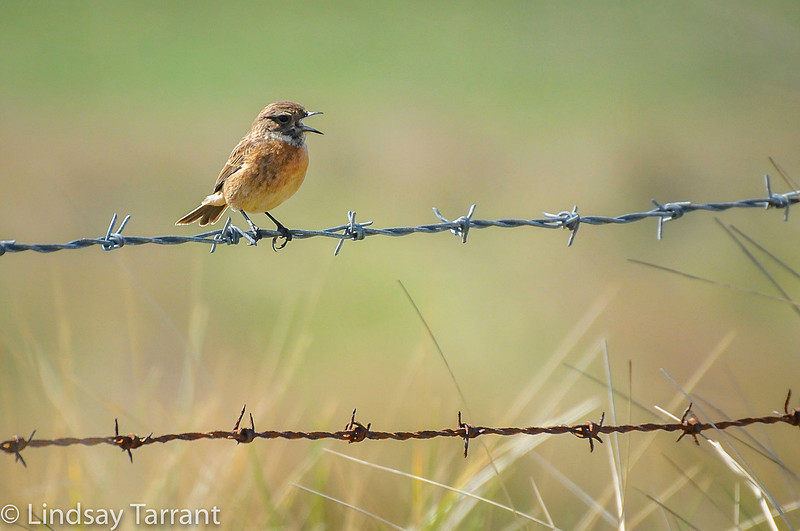
This particular image began as a simple challenge: getting close, unseen. We decided to get away for a week by ourselves. It was Bank Holiday Monday in May 2017 and the beach was four miles of uninterrupted sand, lifted by the wind into a flowing mist six inches above the strand and glowing in the sun. It was both bracing and unbelievably empty: one man, his dog, and us. As we climbed up into the dunes, we found ourselves in much more sheltered terrain. The wind dropped, the air was quiet, and with the sun shining from a blue sky, we were now much warmer. It was now felt more like a lazy Summer day.
It is both a blessing and a curse that as a photographer you are always looking and seeing; sometimes you forget to enjoy the moment. On this particular occasion though, it was a sound that made me aware of an opportunity. Stonechats, as their name suggests, talk to each other with a sound that you might expect to hear if you tap two small stones together. After a bit of stealthy movement, I got to within a few feet of this particular bird.
Now, at home, I sit and reflect on the image and see things I did not appreciate at the time: freedom in the midst of danger; resonance of orange and red; the passage of time; and a soft call on my attention.
The little bird sings her heart out with sharp iron barbs in striking distance and is yet unharmed, carefree, perfectly safe and happy. We all face difficulty and danger from time to time and, like the stonechat’s chest, our colours resonate with the dangers posed by the rusty wires in our past. We are shaped by our challenges, they make us who we are, and when people see us, perhaps they too can see how we wear our russet tones for better or worse.
The rusty old wire still presents a threat but not more so than its new replacement for which, in time, there will be another and another. Likewise, we can be assured of constant challenges which may either transform us, making us either stronger, free and content or restless and fearful of repetition. Finally, our eye is drawn by the contrast between the sharp subjects and the soft focus of the grasslands to our friend (for having considered her but for a moment, we now warm to her) and the fortuitous placement of the wind-blown grass which says ‘look at her’.
So, is it art if it wasn't intended to be? All I know is that, for me, it stirs up memories, feeling and desire. It reminds me that I am cared for by one greater than me and in my dance with the barbed wires of life, it is my attitudes that shape my memories and that the purpose for my life is to make me better tomorrow than I am today.
Perhaps it is art after all and not just a picture I took on a walk one day in May.
