WHAT'S THE POINT?

Having spent many happy times in Paris and having friends who live there, it was very sad to see the pictures of the after-effects of the fire at Notre-Dame last month. The last time we were there was October 2018 and we have a couple of images of the cathedral before the fire, which we will now remember with perhaps more poignancy than we might otherwise have done.
While I do like the many tourist sites in Paris, my favourite place is the Musée D’Orsay. I could cheerfully spend hours there; and sometimes do. In particular, I love the many impressionist galleries to be found there. As I have been developing (forgive the pun) my interest in photography as a subject in its own right rather than just as a simple activity, our last trip held particular significance for me.
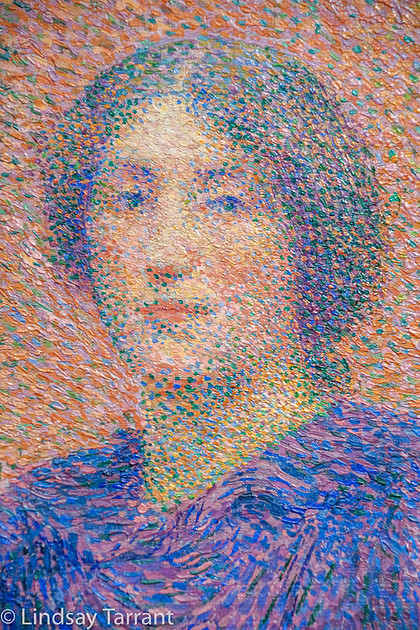
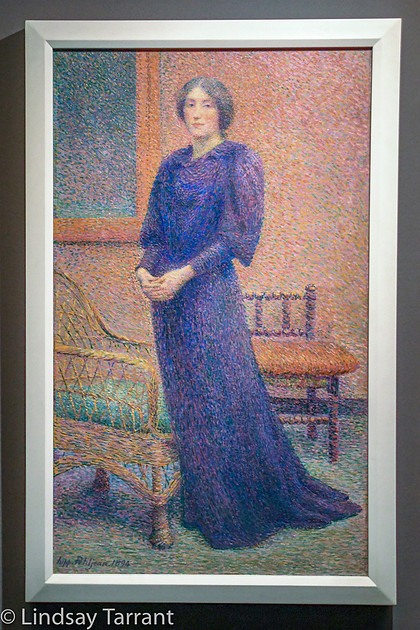
While I love impressionist art, it was several other paintings that caught my attention this time. This month I am sharing with you two images: the first of these is a close up of one particular piece that caught my eye. The painting is Jeune femme debout by Hippolyte Petitjean, painted in 1927, in a pointillist style; that is, painted with many small dots, which only reveal the whole image (the second photo this month) when you step back to see the picture from a distance.
Several things struck me on seeing this. As the technology becomes available, we are all driven, albeit willingly, towards higher and higher megapixel counts; if your phone doesn’t have at least 12 megapixels, preferably 20, then it isn’t much good, so some might say. I myself have spent more than a few minutes contemplating what it would be like to use something like a Hasselblad X1D with its 50 megapixels, however, without re-mortgaging the house that isn’t going to happen L.
It seems that we are taken up with using digital equipment that has better and better resolution so that the images we take are less and less differentiable from real life. Interestingly, even now we are barely at the resolution that we used to obtain with film cameras and silver negatives.
In these images, however, we have a painting that holds fascination not because the resolution is very fine, but because it shows us how remarkable is our eyesight and the processes of our brains. As we stand back, our minds render the image in continuous smooth lines, until we look closely and see that, in truth, it comprises a series of discrete points.
As those of you who have read my previous articles will know, I have been reading through the Selected Writings of John Ruskin and, as you can now see, I read really slowly! In one of his pieces, he makes an interesting comment on this subject:
“First, place an object as close to the eye as you like, there is always something in it which you cannot see … You can see the texture of a piece of dress, but you cannot see the individual threads which compose it, though they are all felt, and have each of them influence on the eye. Secondly, place an object as far from the eye as you like, and until it becomes in itself a mere spot, there is always something in it which you can see … Its shadows and lines and local colours are not lost sight of as it retires; they get mixed and indistinguishable, but they are still there, and there is a difference always perceivable between an object possessing such details and a flat or vacant space. The grass blades of a meadow a mile off, are so far discernible that there will be a marked difference between its appearance and that of a piece of wood painted green. And thus nature is never distinct and never vacant, she’s always mysterious, but always abundant; you always see something, but you never see all.”
The search for ever higher resolution in our cameras is therefore doomed to frustration, because, as the resolution improves, there will always be something we cannot resolve; and ultimately, if we could achieve what it is we seek then, as Lewis Carroll pointed out, a map on a scale of one to one is of no use at all[1].
What we are left with is the truth that we need only sufficient resolution as is necessary to communicate what we wish to convey. It strikes me that this is also true of beliefs.
Deep down, we know we cannot know everything. We also know that there are many things we can examine, explore and know. But, we do not need to know everything to get the point of what is being said to us.
And yet, when it comes to matters of faith, we are often tempted to seek for finer and finer resolution to questions and issues before we are prepared to accept that the matter is true. We holds to the view that unless we have ultimate clarity on a matter, then everything is false. Essentially, because we cannot have a map on a scale of one to one, we say that the map we have been given must be of no use so we reject the concept of faith entirely.
Perhaps next time we are faced with such choices, we might just step back, see the whole image and accept that it is made up of a series of points which, taken together, allow us to comprehend what the artist wished to convey; after all, if it were proof, it would not be faith.
[1]Sylvie and Bruno Concluded, by Lewis Carroll, 1893:
“That’s another thing we’ve learned from your Nation,” said Mein Herr, “map-making. But we’ve carried it much further than you. What do you consider the largest map that would be really useful?” “About six inches to the mile.” “Only six inches!” exclaimed Mein Herr. “We very soon got to six yards to the mile. Then we tried a hundred yards to the mile. And then came the grandest idea of all! We actually made a map of the country, on the scale of a mile to the mile!” “Have you used it much?” I enquired. “It has never been spread out, yet,” said Mein Herr: “the farmers objected: they said it would cover the whole country, and shut out the sunlight! So we now use the country itself, as its own map, and I assure you it does nearly as well.”
