COMPOSE YOURSELF
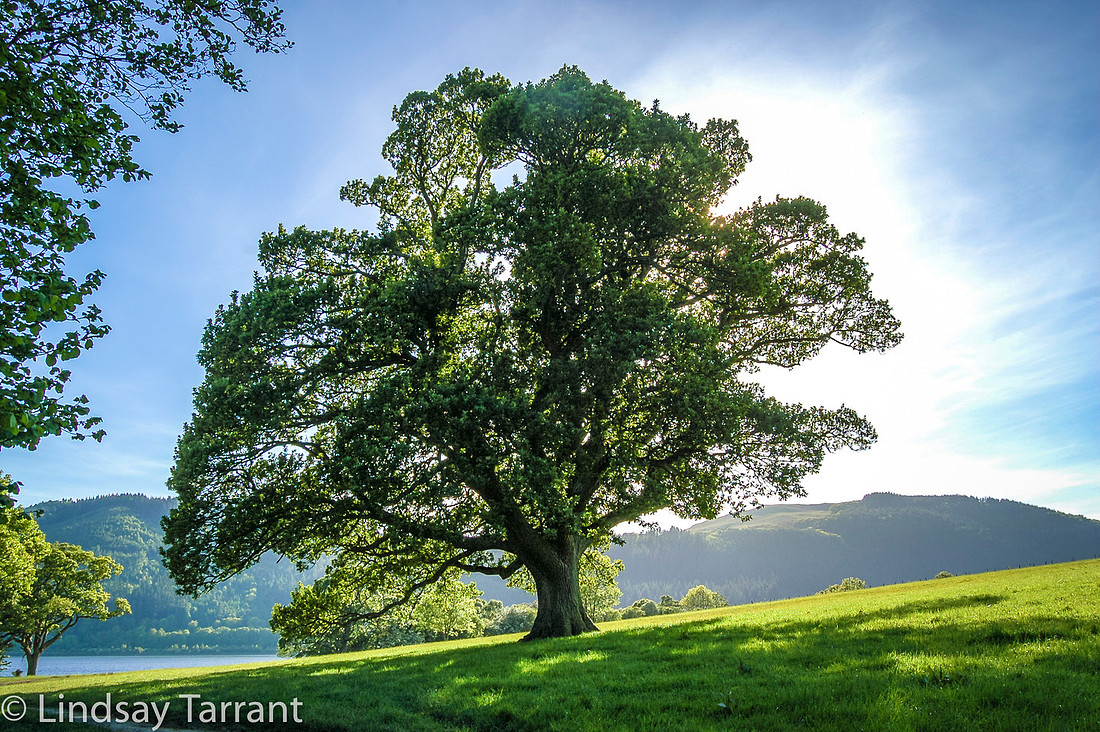

Trees are all around us and we so often take them for granted; we drive by them; we walk underneath them; we plant them in our gardens; we would die without them. It makes me particularly happy to see mature trees, upright and proud, comfortable in their own surroundings, having developed naturally to become what was supposed to be; standing tall with naturally composed lines in a beauty all their own.
I recently bought a copy of the Selected Writings of John Ruskin. It was an impulse buy, but I really like his style. In Modern Paintings, he describes two artists painting a tree. The first is an unimaginative painter, creating (if it can be called creating) and arranging each separate element of the painting according to the proper rules of art. The second is an imaginative free spirit of whom Ruskin says:
“The advance of the imaginative artist is precisely the reverse of this. He owns no laws. He defies restraint … there is nothing within the limits of possibility that he does not dare do … He saw his tree, trunk, boughs, foliage and all, from the first moment; not only the tree, but the sky behind it; not only that tree or sky, but all the other great features of his picture.”
Having described these two artists, Ruskin then makes an interesting observation on the subject of composition. He says of the first painting:
“… on removing any part or parts of it, though the rest will indeed suffer … the portions left are not made discordant or disagreeable … every stem a perfect stem, and every twig a graceful twig…”
In short, each element is well composed in and of itself but does not rely on any other. In contrast, he says of the imaginative artist:
“But if we try the same experiment on the imaginative painter’s work, and break off the merest stem or twig of it, it all goes to pieces like a Prince Rupert’s drop … take it away and the boughs will sing to us no longer. All is dead and cold.”
My feeling is that it is the same with good photography. The kind of composition I aspire to create is where each image is so well balanced it could not be any other way. In his book The Photographer’s Eye, Michael Freeman, a travel photographer for many well-known publications, comments on the subject of composition:
“As a working photographer, organising all the stuff that has to fit in the frame was what occupied my shooting mind most of the time … my argument for composition and its absolutely central role in photography [is]… all about the photographer being in control. It’s the only thing that puts you and me in charge of organising all the chaos in front of the camera into an actual, engaging photograph. It always has been, and it always will be.”
I think there is a lesson here for us too about our own composition. Most of us have occasionally thought about how we might best be composed. The following words recorded in Psalm 1 were written some three thousand years ago about a blessed and content man who seems to be like that: “He is like a tree planted by streams of water which yields its fruit in season and whose leaf does not wither. Whatever he does prospers.”
A large tree will absorb and breathe out hundreds of gallons of water a day, hence the need to have ready access to deep regular supplies of water. It seems that, if we want to be content and fruitful, we also need a ready source of ‘water’ flowing through us to produce fruit. The question is: what is this water and where do we get it?
The words in Psalm 1 are also echoed in the gospel of John Chapter 15: “… my father is the gardener. He cuts off every branch in me that bears no fruit, while every branch that does bear fruit, he prunes so that it will be even more fruitful.”
Some years ago, we planted a silver birch. In truth, our garden isn’t really big enough for such a naturally tall tree, so we ended up pruning it to prevent it growing any higher. I have observed with pruning that, as the tree grow and matures, our changes are magnified and, unless we have been quite careful, severe changes made too young risk making a lasting negative impact. Sadly, I have observed the same with people.
What we really need is kind and tender pruning to ensure that we develop well and bear a constant supply of fruit and, when pruning comes, to remember that is to make us better, despite how it may feel.
So, where do we find this supply of water and one who is prepared to prune us well? The Bible is clear about that. He is the one who stands behind us to make us what we are supposed to be and when others see us they see his radiance and are able to say of us: we had good composition; that there is no other way in which we could have be what we are; that every element was absolutely necessary and, if even one were absent, we would sing no longer, all would have be dead and cold.
I hope you like the blog image this month and that, after reading these thoughts, it might take on a different significance for you as you take a few seconds to take a final look. Until next month ...
